India's Telecom Regulatory Framework Enters Its Biggest Transformation Since the Unified Licence
India's telecom sector has witnessed another landmark reform. Following the enactment of the Telecommunications Act, 2023, the Government has notified the Telecommunications (Authorisation for Provision of Principal Telecommunications Services) Rules, 2026, replacing the long-standing licensing architecture built around the Unified Licence (UL) and Unified Licence–Virtual Network Operator (UL-VNO) framework.
For more than a decade, the Unified Licence Guidelines of 2013 and the UL-VNO Guidelines provided the foundation for licensing telecom service providers. While they successfully enabled convergence of telecom services, the framework gradually became document-intensive, licence-centric and administratively complex.
The Principal Telecom Services Rules, 2026 introduce a fundamentally different philosophy. Rather than merely updating licence conditions, they replace the licensing model with a modern, digital-first authorisation regime that is aligned with the Telecommunications Act, 2023.
From Licence to Authorisation – A Paradigm Shift
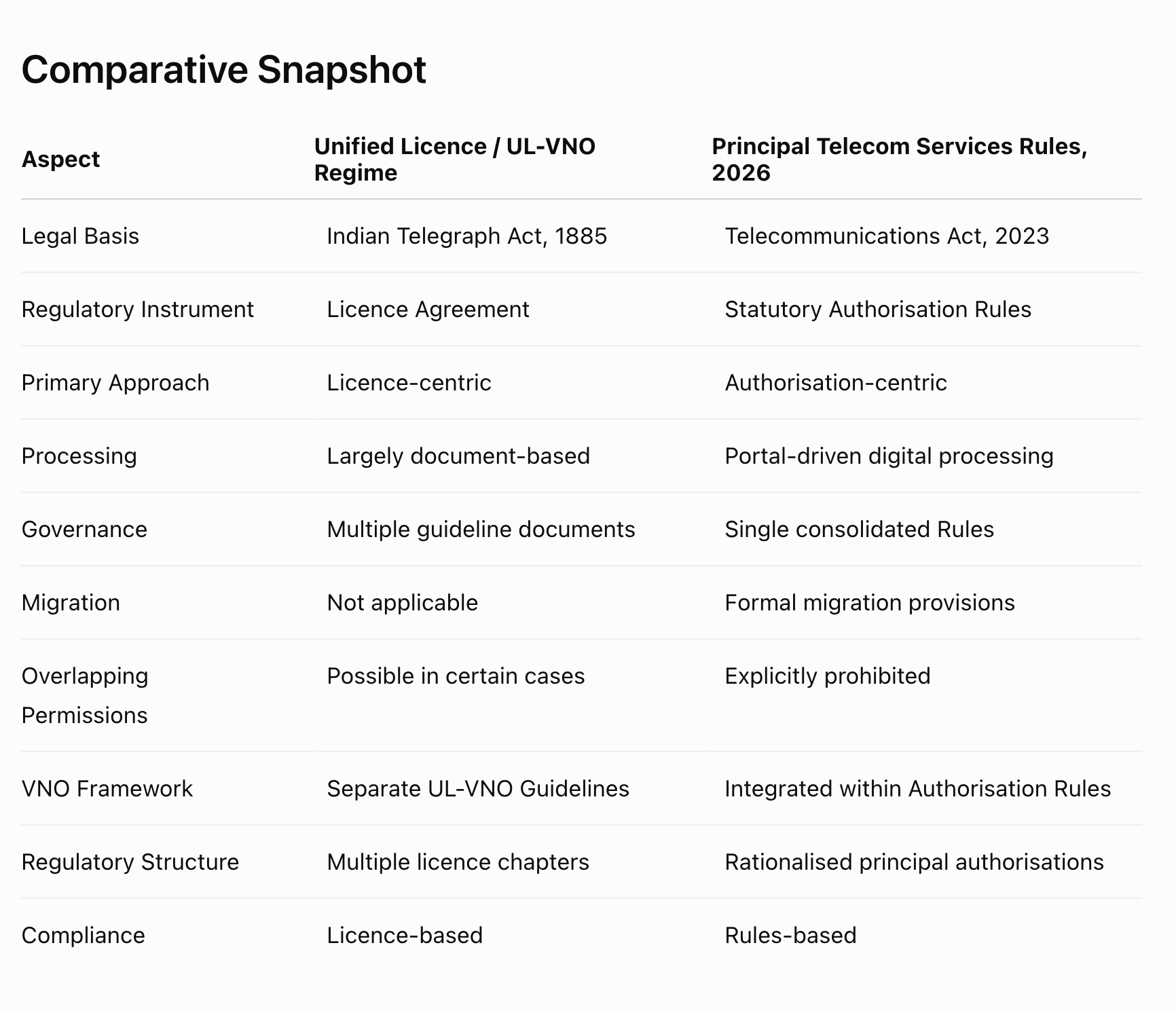
Perhaps the most significant reform is the shift from the traditional "Licence" regime under the Indian Telegraph Act, 1885 to an "Authorisation" regime under the Telecommunications Act, 2023. This change is far more than a change in terminology.
The new framework recognises telecom authorisation as a transparent regulatory permission governed through statutory rules rather than detailed contractual licence agreements. Existing licensees have also been provided a structured migration path to move to the new authorisation regime.
Digital-First Governance
One of the strongest features of the 2026 Rules is complete digitalisation of regulatory processes.
Unlike the earlier UL framework where applications, clarifications and documentation involved multiple physical and manual processes, the new Rules mandate that applications, certifications, undertakings, approvals and authorisations shall be processed through a designated online Portal.
The Portal becomes the single interface for:
- submission of applications
- eligibility certification
- processing fees
- issue of Letter of Intent
- grant of authorisation
- submission of undertakings
- ongoing compliance
This significantly reduces paperwork, improves transparency and shortens processing timelines.
Simplified Service Architecture
Under the Unified Licence regime, telecom operators were required to obtain separate authorisations for multiple services within the licence.
The 2026 Rules reorganise the framework around five principal authorisations:
- Unified Service Authorisation
- Access Service Authorisation
- Wireline Access Service Authorisation
- Internet Service Authorisation
- Long Distance Service Authorisation
This rationalisation creates a cleaner regulatory structure while preserving flexibility for operators to offer multiple telecom services.
Clear Distinction Between Network Operators and Virtual Network Operators
Another notable reform is the explicit recognition of two categories of service providers:
- Network Service Operators (NSO)
- Virtual Network Operators (VNO)
While UL-VNO Guidelines introduced Virtual Network Operators separately, the new Rules integrate both categories within one unified statutory framework with clearly defined rights, responsibilities and migration provisions.
This creates regulatory consistency while reducing duplication across separate guideline documents.
Migration Instead of Fresh Licensing
Existing holders of:
- Unified Licence
- Unified Access Service Licence
- ISP Licence
- National Long Distance Licence
- International Long Distance Licence
- UL-VNO
are not forced into immediate replacement.
Instead, the Rules provide an orderly migration mechanism whereby existing licensees may migrate to corresponding authorisations under Section 3(6) of the Telecommunications Act, 2023.
This ensures business continuity while enabling gradual transition to the new regulatory framework.
Overlapping Licences Eliminated
Under the previous regime, operators occasionally maintained overlapping licences or authorisations while expanding services.
The 2026 Rules expressly prohibit overlapping licences or authorisations covering the same scope and service area.
Applicants are required to surrender overlapping licences while obtaining new authorisations.
This reduces regulatory duplication, avoids multiple compliance obligations and creates greater clarity in the authorisation structure.
Greater Transparency in Eligibility
Eligibility conditions have been standardised.
The Rules clearly prescribe requirements relating to:
- paid-up equity
- net worth
- FDI compliance
- outstanding dues
- financial certification by statutory auditors
Unlike the earlier guidelines where several eligibility conditions were scattered across annexures and licence documents, the new Rules consolidate these requirements into a single statutory framework.
- Spectrum Continues to Remain Separate
- The Unified Licence introduced the important principle that spectrum allocation is independent of licensing.
- The 2026 Rules continue this policy.
- Obtaining an authorisation does not automatically confer any right over spectrum. Spectrum continues to be assigned separately under applicable spectrum allocation policies.
This preserves the market-based spectrum management approach adopted by Government over the last decade.
Reduced Regulatory Complexity
One of the major achievements of the new Rules is regulatory simplification.
Instead of relying on:
- Licence Agreements
- UL Guidelines
- UL-VNO Guidelines
- Multiple amendments
- Circulars
- Clarifications
service providers now have a comprehensive statutory rulebook covering authorisation, eligibility, migration, obligations and compliance.
This substantially improves legal certainty and ease of interpretation.
Business-Friendly Compliance
The Rules introduce several business-friendly features including:
- single online application process
- standardised eligibility verification
- statutory migration provisions
- clearly defined authorisation categories
- transparent authorisation grant process
- simplified documentation
- non-exclusive authorisation framework
- elimination of duplicate licences
Collectively, these reforms reduce administrative burden on both telecom operators and the Department of Telecommunications.
Financial Rationalisation
While the detailed financial obligations are now linked to the respective schedules and authorisation conditions, the overall policy direction reflects rationalisation rather than expansion of regulatory burden.
The move away from multiple licence-specific documentation, consolidation of authorisations and elimination of overlapping permissions is expected to reduce compliance costs for operators.
Any reduction in processing charges, entry fees, guarantees or recurring authorisation fees will depend upon the specific schedules applicable to each category of authorisation.
What This Means for the Telecom Industry
The Principal Telecom Services Rules, 2026 represent one of the most comprehensive regulatory reforms undertaken by the Department of Telecommunications in recent years. Rather than introducing incremental amendments, the Rules redesign the regulatory architecture itself.
The emphasis has shifted towards:
- ease of doing business
- digital governance
- transparent authorisation
- simplified compliance
- technology-neutral regulation
- reduced administrative burden
- seamless migration from legacy licences
These reforms are expected to benefit not only large telecom operators but also Internet Service Providers, Virtual Network Operators, enterprise service providers and new market entrants by making regulatory compliance more predictable, transparent and efficient.
As India's digital economy continues to expand rapidly, the new authorisation framework lays the foundation for a modern telecom ecosystem that is simpler to administer, easier to comply with and better aligned with future technologies.
The Principal Telecom Services Rules, 2026 therefore mark not merely a regulatory update, but a structural transformation of India's telecom governance framework—one that reflects the country's vision of a digitally enabled, innovation-driven and globally competitive telecommunications sector.


 Beta
Beta







India's Telecom Regulatory Framework Enters Its Biggest Transformation Since the Unified Licence
India's telecom sector has witnessed another landmark reform. Following the enactment of the Telecommunications Act, 2023, the Government has notified the Telecommunications (Authorisation for Provision of Principal Telecommunications Services) Rules, 2026, replacing the long-standing licensing architecture built around the Unified Licence (UL) and Unified Licence–Virtual Network Operator (UL-VNO) framework.
For more than a decade, the Unified Licence Guidelines of 2013 and the UL-VNO Guidelines provided the foundation for licensing telecom service providers. While they successfully enabled convergence of telecom services, the framework gradually became document-intensive, licence-centric and administratively complex.
The Principal Telecom Services Rules, 2026 introduce a fundamentally different philosophy. Rather than merely updating licence conditions, they replace the licensing model with a modern, digital-first authorisation regime that is aligned with the Telecommunications Act, 2023.
From Licence to Authorisation – A Paradigm Shift
Perhaps the most significant reform is the shift from the traditional "Licence" regime under the Indian Telegraph Act, 1885 to an "Authorisation" regime under the Telecommunications Act, 2023. This change is far more than a change in terminology.
The new framework recognises telecom authorisation as a transparent regulatory permission governed through statutory rules rather than detailed contractual licence agreements. Existing licensees have also been provided a structured migration path to move to the new authorisation regime.
Digital-First Governance
One of the strongest features of the 2026 Rules is complete digitalisation of regulatory processes.
Unlike the earlier UL framework where applications, clarifications and documentation involved multiple physical and manual processes, the new Rules mandate that applications, certifications, undertakings, approvals and authorisations shall be processed through a designated online Portal.
The Portal becomes the single interface for:
This significantly reduces paperwork, improves transparency and shortens processing timelines.
Simplified Service Architecture
Under the Unified Licence regime, telecom operators were required to obtain separate authorisations for multiple services within the licence.
The 2026 Rules reorganise the framework around five principal authorisations:
This rationalisation creates a cleaner regulatory structure while preserving flexibility for operators to offer multiple telecom services.
Clear Distinction Between Network Operators and Virtual Network Operators
Another notable reform is the explicit recognition of two categories of service providers:
While UL-VNO Guidelines introduced Virtual Network Operators separately, the new Rules integrate both categories within one unified statutory framework with clearly defined rights, responsibilities and migration provisions.
This creates regulatory consistency while reducing duplication across separate guideline documents.
Migration Instead of Fresh Licensing
Existing holders of:
are not forced into immediate replacement.
Instead, the Rules provide an orderly migration mechanism whereby existing licensees may migrate to corresponding authorisations under Section 3(6) of the Telecommunications Act, 2023.
This ensures business continuity while enabling gradual transition to the new regulatory framework.
Overlapping Licences Eliminated
Under the previous regime, operators occasionally maintained overlapping licences or authorisations while expanding services.
The 2026 Rules expressly prohibit overlapping licences or authorisations covering the same scope and service area.
Applicants are required to surrender overlapping licences while obtaining new authorisations.
This reduces regulatory duplication, avoids multiple compliance obligations and creates greater clarity in the authorisation structure.
Greater Transparency in Eligibility
Eligibility conditions have been standardised.
The Rules clearly prescribe requirements relating to:
Unlike the earlier guidelines where several eligibility conditions were scattered across annexures and licence documents, the new Rules consolidate these requirements into a single statutory framework.
This preserves the market-based spectrum management approach adopted by Government over the last decade.
Reduced Regulatory Complexity
One of the major achievements of the new Rules is regulatory simplification.
Instead of relying on:
service providers now have a comprehensive statutory rulebook covering authorisation, eligibility, migration, obligations and compliance.
This substantially improves legal certainty and ease of interpretation.
Business-Friendly Compliance
The Rules introduce several business-friendly features including:
Collectively, these reforms reduce administrative burden on both telecom operators and the Department of Telecommunications.
Financial Rationalisation
While the detailed financial obligations are now linked to the respective schedules and authorisation conditions, the overall policy direction reflects rationalisation rather than expansion of regulatory burden.
The move away from multiple licence-specific documentation, consolidation of authorisations and elimination of overlapping permissions is expected to reduce compliance costs for operators.
Any reduction in processing charges, entry fees, guarantees or recurring authorisation fees will depend upon the specific schedules applicable to each category of authorisation.
What This Means for the Telecom Industry
The Principal Telecom Services Rules, 2026 represent one of the most comprehensive regulatory reforms undertaken by the Department of Telecommunications in recent years. Rather than introducing incremental amendments, the Rules redesign the regulatory architecture itself.
The emphasis has shifted towards:
These reforms are expected to benefit not only large telecom operators but also Internet Service Providers, Virtual Network Operators, enterprise service providers and new market entrants by making regulatory compliance more predictable, transparent and efficient.
As India's digital economy continues to expand rapidly, the new authorisation framework lays the foundation for a modern telecom ecosystem that is simpler to administer, easier to comply with and better aligned with future technologies.
The Principal Telecom Services Rules, 2026 therefore mark not merely a regulatory update, but a structural transformation of India's telecom governance framework—one that reflects the country's vision of a digitally enabled, innovation-driven and globally competitive telecommunications sector.
Leave a Comment